

The Stoic Quote of the Week
“Why do we complain about nature? She has acted kindly: life is long if you know how to use it. But one man is gripped by insatiable greed, another by a laboritous dedication to useless task.”
-Seneca
Hey there!
It’s been a minute since I wrote a Gutter Thoughts post.
The only reason for the pause was time. For the last few months I’ve been working overtime on growing my newsletter ghostwriting business. It’s a business of just one, so outreach, follow-up, and writing all fall on me. If I’m saying yes to one thing, I’m saying no to something else. In this case, that something else was Gutter Thoughts.
The good news is I want to keep writing. I’ve been doing more of it in the mornings with journaling. That’s what finally pushed this one out.
Because I’ve got a lot of thoughts I want to share — about philosophy, creativity, and comics — and it does me no good to keep them to myself.
So thank you for sticking around. And now to today’s Gutter Thought.
What if the reason your comic isn’t done has nothing to do with talent?
Most creators won’t admit this hard truth: the comic project sitting unfinished on your desk, your iPad, your sketchbook, isn’t stuck because you lack skill. It’s paused because your process is working against you. And a bloated, overcomplicated process is the silent killer of creative momentum. Here’s how it shows up:
Staring at a blank page for an hour before drawing a single line.
Spending more time setting up your workspace than actually crafting.
Feeling burned out before you even hit the midpoint of a project.
Telling yourself you’ll “get back to it” and then not.
The good news?
None of that is permanent.
It’s fixable.
And the fix isn’t working harder or grinding longer hours.
It’s simplifying.
Today, I’m walking you through exactly how to strip your comic-crafting process down to what actually matters so you spend less time in your head and more time crafting pages.
Let’s get into it.
The real reason you won’t simplify (and it’s not what you think).
Most creators assume they’re overcomplicating things because they’re perfectionists.
And sure, that’s part of it.
But there are actually three reasons this happens, and only one of them is about perfectionism.
The first reason is tradition.
There’s this unspoken belief in comics culture that if you’re not doing it the “right” way (i.e using bristol board paper, india ink, hand lettering) you’re somehow less legitimate.
But you must grasp this fundamental truth: Readers. Do. Not. Care.
They want a good story told well. That’s it.
And if we’re being real, if you truly wanted to be a traditionalist, you’d be making the paper and ink from scratch.
And nobody has time for that.
So let that one go.
The second reason is fear.
A complicated process is a great hiding spot.
If there are seventeen steps between your idea and a finished page, you never have to face the moment the work is out in the world, and someone has an opinion about it.
Simplifying removes that buffer. And that’s terrifying.
But staying complicated means staying invisible, and that’s worse.
Marcus Aurelius said it plainly:
“Do what nature demands. Get a move — if you have it in you — and don’t worry whether anyone will give you credit for it.”
Just do the work.
The third reason is the most innocent: you just didn’t know there was a better way.
A lot of creators are grinding through inefficient workflows simply because nobody showed them the shortcut.
If that’s you, consider this your sign.
What actually happens when you simplify?
When you cut the unnecessary steps out of your process, three things shift almost immediately.
First, the friction between idea and execution drops.
That gap between “I have a great idea” and “I’m actually drawing it” is where most projects go to die.
A simplified process doesn’t make the mountain disappear.
It just means you show up with the right gear.
Second, you work faster. Not rushed but efficient.
When decisions are already made upfront, you stop burning creative energy on logistics.
You just make things.
Marcus Aurelius said it best:
“Concentrate every minute like a Roman — on doing what’s in front of you with precise and genuine seriousness, tenderly, willingly, with justice. And on freeing yourself from all other distractions.”
That’s what a simplified process gives you. The ability to just be present with the work.
Third, and this one matters most: you start to feel good about the work.
Pride.
Joy.
That feeling of looking at a finished page and thinking, “I made that.”
If you simplify and still feel no joy, that’s useful data.
It means you might need to pivot the project itself, not just the workflow. That’s not failure. That’s information.
The moment everything changed for me.
In 2013, I read a small, eight-page comic stapled together, apparently printed at home.
It was simple with the most beautiful art.
It was titled, The End of the F**king World.
After reading this gem, it hit me: comics are about being as quick and efficient as possible at your own pace.
Nothing more.
That same lesson followed me into my time as a writer at Apple.
It was there I consistently saw three words posted throughout the buildings as a constant reminder:
Simplify, Simplify, Simplify.
Those words became my compass whenever I was stuck or burned out.
And they’re the words that helped me finish my comic, Boom Kid: The Ultimate Beef EP.
They push me to overhaul my entire process, ditch the traditional setup, and move fully to the iPad and Procreate.
But nearly ten years later, I had to do it all over again.
Getting back into the second half of Boom Kid, I realized I’d been working digitally but still thinking traditionally, buried in formatting steps and layout decisions before I’d drawn a single line.
By the time I was ready to create, I was already drained.
So I simplified again.
And the version of my process I’m running now, idea in my notes app, script in my sketchbook, thumbnails on iPad, one consistent digital paper format, is the leanest and most joyful it’s ever been.
The lesson isn’t that you simplify once. It’s that you keep simplifying.
Simplifying your process in 4 steps.
Step 1: Audit your current process like you mean it.
Write down every single step you take from the moment an idea hits to the moment a page is done.
Every step: opening the app, finding a reference, and resizing your canvas. All of it.
Most creators have never done this.
They run on autopilot and wonder why they feel drained. Get it all out first. Don’t judge it yet. Just map it.
Step 2: Separate what you love from what you dread.
Split your list into two columns: what you enjoy and what you don’t.
Next to each thing you enjoy, note roughly how long it takes.
This tells you where your energy flows naturally and where your time is actually going.
Don’t overthink the rating system. The gut check is almost always right.
Step 3: Cut what’s dead weight and upgrade what’s dragging.
Some steps can simply be eliminated. They exist out of habit, not necessity.
Others are unavoidable but can be made faster with a tool switch, a template, or just a different order of operations.
And don’t overlook the steps you enjoy. Ask how you can do those faster too.
Nothing is precious. Everything can be tested.
Step 4: Outsource whatever you’re not the best person to do.
Pick up any comic off your shelf and flip to the credits.
You’ll almost always find at least four people listed.
Comics was never meant to be a solo sport.
If lettering is slowing you down and someone else can do it better, find that person.
Giving up a little control over one part of the process is absolutely worth it if it means the book actually gets finished.
Unfinished and 100% yours helps no one.
The best time to simplify was yesterday. The second-best time is now.
Simplifying your process isn’t a one-time fix. It’s an ongoing practice.
The more you do it, the more you overcome the fear, the faster you work, and the more joy you find in the crafting.
You don’t have to overhaul everything at once.
Start with one step. Cut one thing that isn’t serving you. Test something new for a month.
See what happens.
Marcus Aurelius put it best:
“Identify its purpose — what makes it what it is — and examine that. Ignore its concrete form. Then calculate the length of time that such a thing was meant to last.”
Your process was never meant to stay the same forever.
Examine it. Strip it down to what it’s actually for. Then build from there.
Simplify, Simplify, Simplify.
Don’t wait ten years to figure out you were making this harder than it needed to be.
This Week’s Creative Sparks
Here are the shows, books, movies, comics, and more that have sparked my creativity this week:
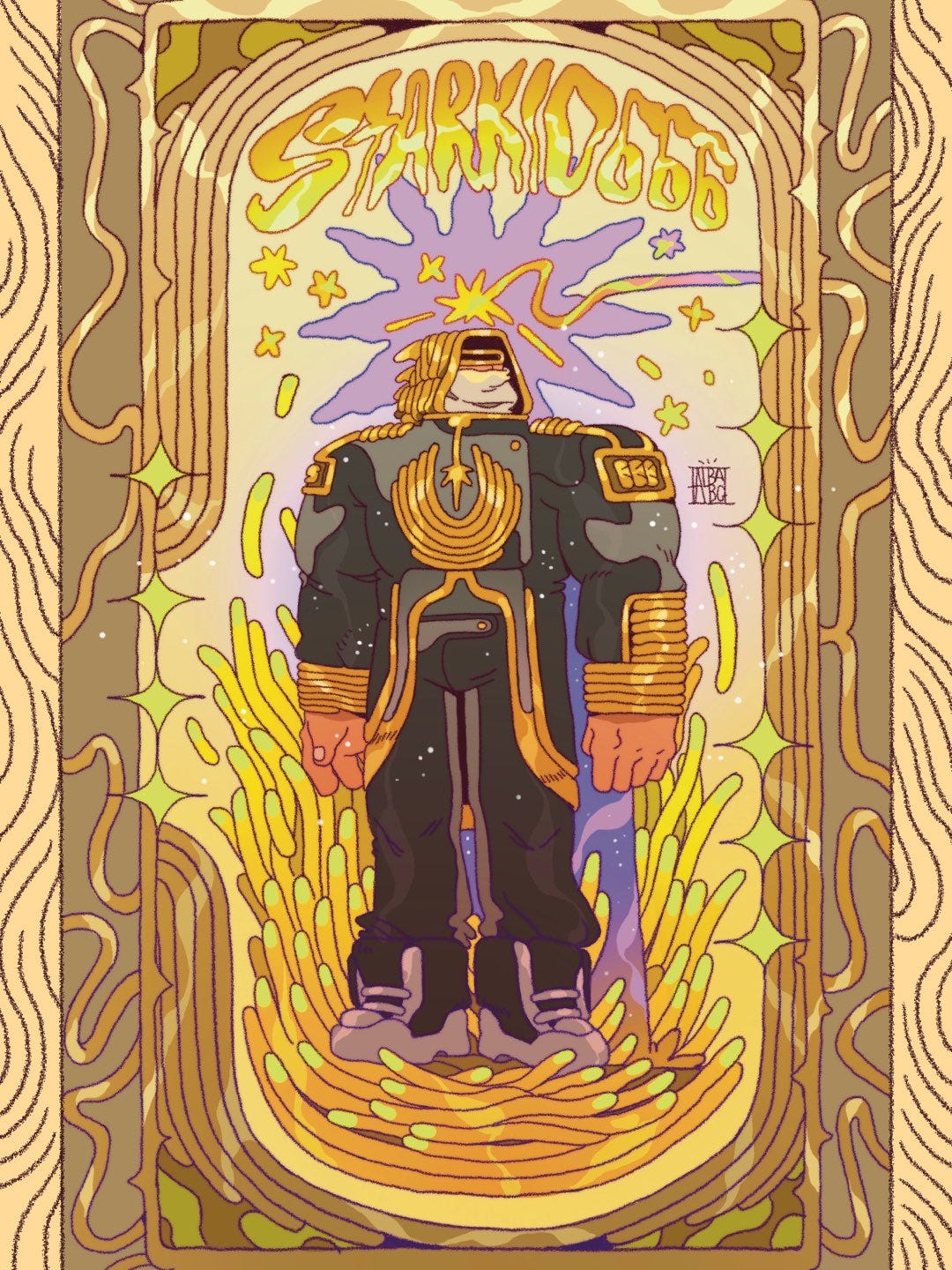
Starkid666: The Eggs of Hope Vol. 1
David, aka Davilorum, is an artist whose work has been on my radar for a few years now.
His style is cartoony with this undercurrent of anime influence, the kind of thing that’s instantly pleasing to look at but has actual craft underneath it.
He’s had a story I’ve been wanting to read called StarKid666. Traditional publishing didn’t work out. So he did what more creators should do: he took matters into his own hands.
The Kickstarter for Volume 1, The Eggs of Hope, is already fully funded. Congrats to him. But there are only a few days left if you want to get in on it, and it’s priced in a way that makes it an easy yes.
Go support it.
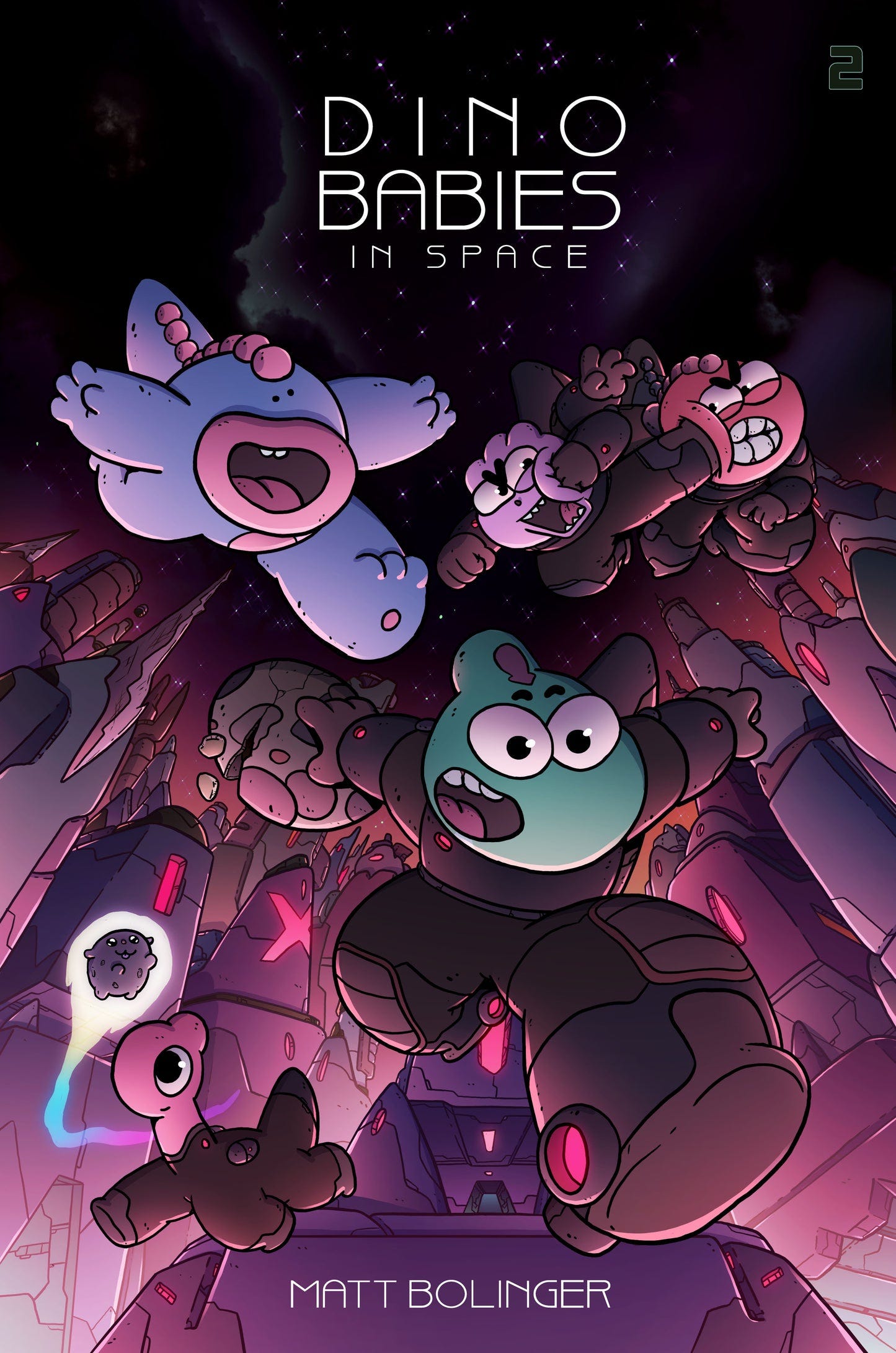
Dino Babies in Space Volume 2
Dino Babies in Space is one of the best all-ages comics on the stands right now.
The last survivors of a dying planet. Matt Bolinger built this book from scratch — writing, drawing, and funding it himself. Volume two is out, and it delivers.
Great characters, with real funny moments, and lessons that land without lecturing.
If you haven’t picked it up yet, do it. You won’t regret the time you spend in this world.
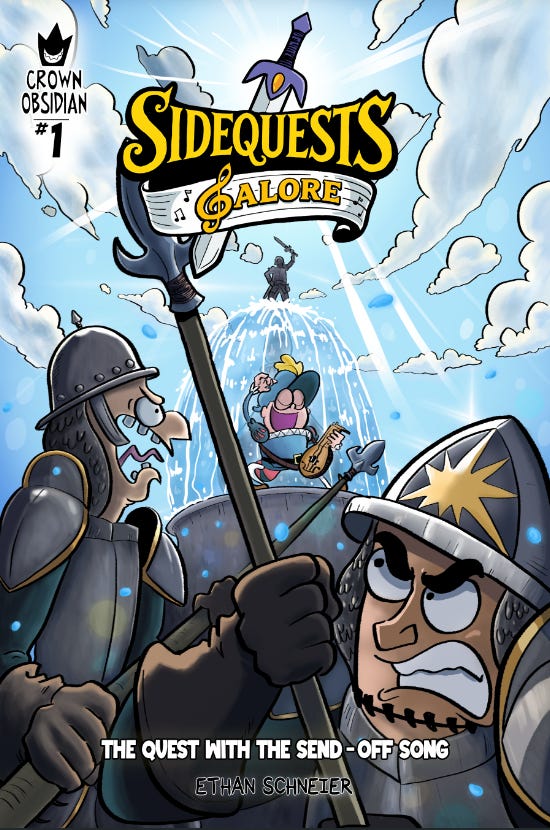
Sidequests Galore # 1
If you want a fantasy comic that’ll have you smiling all day — check out Sidequests Galore.
Ethan is a cartoonist I met recently and one of the most talented creator/YouTubers I’ve come across. He knows how to hook you and keep you there.
Sidequests Galore was him trying something new, and it works. By the end of part 1 I was ready for more. Parts 2 and 3 come out later this year, and I’m already waiting.
36 pages at $3. Reminds of the good old comic book days.
That’s a wrap for this week’s Gutter Thoughts. Thanks for joining me on this creative journey—hopefully, something here sparked an idea or inspired your own work. Until next time, stay grounded, stay creative, and keep pushing forward.
This issue is sponsored by me.
I created Cut the Learning Curve, a free 5-day course for aspiring comic creators who are ready to stop guessing and start creating with confidence.
And if you’re more of a founder or creative team who wants this done for you, I also ghostwrite story-driven newsletters that build trust and drive conversion.
Great read as always. I've been thinking about simplifying my general process for illustration. The only 'problem' is that the result will be necessarily different. Not a bad thing... I suppose that would imply a transition between 'what my work used to look like' and 'what it is now'. Not as easy for current clients? But I guess that is still fear, as you said. What if everything is suddenly more comfortable and effective, AND the result is actually preferred? :-)